The Certified B Corporation: A Definition and Brief History of How It All Started?
This article will give you a basic understanding of what a Certified B Corporation is and how it developed into what it is today.
Definition
Per the B Corp Handbook, Certified B Corporations “are companies that have been certified to have met rigorous standards of social and environmental performance, accountability, and transparency. B Corp Certification is similar to Leadership in Energy and Environmental Design (LEED) certification for green buildings, Fairtrade certification for coffee, or USDA Organic for milk. A key difference, however, is that B Corp certification is based on the assessment of an entire company and its practices (such as worker engagement, community involvement, environmental footprint, governance structure, and customer relationships) rather than assessing a single aspect or element of a company (such as the building or a product [it produces or sells]). This big picture evaluation is important because it helps distinguish between good companies and just good marketing.”
The Certified B Corporation is the gold-standard certification for businesses who want to show their leadership as responsible corporate citizens acting with a purpose. Let’s look back at how it all started.
History
The Certified B Corporation Movement was started by three individuals, Jay Coen Gilbert, Bart Houlahan, and Andrew Cassoy. Jay and Bart were co-founders of AND1, a basketball footwear and clothing company. During the 1990s, AND1 was a poster child for what a socially responsible business could look like. They had great parental leave benefits, widely shared ownership of the company, gave 5% of profits to charity each year, and worked with overseas suppliers to ensure worker health, safety, fair wages, and professional development. They even had on-site basketball courts and offered on-site yoga classes before it became mainstream to offer that type of perk.
With all of this, AND1 was also a profitable company, and was pulling in annual revenues of $250 million by 2001. However, growth eventually stagnated and the founders decided to sell the company in 2005. Almost immediately after the sale, all of the company’s pre-existing commitments to its employees, overseas workers and the local community were stripped away.
Jay and Bart were devastated and realized the incredible need for businesses to have a more permanent structure surrounding their social and environmental practices. They also became inspired by hearing stories about iconic brands such as Patagonia, Newman’s Own and Ben & Jerry’s prioritizing socially and environmentally responsible practices. They decided to take action and linked up with their former Wharton classmate, Andrew Kassoy, who worked at a private equity firm focused on social change. More information about the history of B Lab and its founders can be found in this article, written by the B Corp Handbook’s co-author, Ryan Honeyman.
In 2006, the three of them launched B Lab, a nonprofit organization that serves a global movement of people using business as a force for good. B Lab is responsible for managing B Corp Certification, administering the B Impact Management Programs and Software, and advocacy for governance structures like the benefit corporation.
A New Evaluation Framework is Born
Over the next year, the new team at B Lab would work with leading businesses, investors and attorneys to create a comprehensive set of performance and legal requirements. They certified the first B Corporation in 2007.
The three main criteria
businesses must meet to become certified B Corporations are 1) Verified social and environmental performance, 2) Legal accountability and 3) Public transparency.
The social and environmental performance
component
is evaluated using the B Impact Assessment. The B Impact Assessment is a free, confidential, easy-to-use online management tool that generates a score based on a 200 point scale. The assessment evaluates companies across five main categories, including Governance, Workers, Community, Environment and Customers. In order to become certified, companies must achieve a minimum score of 80 points. Upon completion, companies also receive a B Impact Report, which is a summary of their B Impact Assessment by category.
In addition to meeting performance standards, B Lab decided that businesses must also fulfill the legal requirement, and have legal accountability
. The need for this became apparent to Jay and Bart after witnessing AND1’s social and environmental practices evaporate right before their eyes following the sale of their company. The legal requirement ensures that Certified B Corporation’s best practices are baked into the DNA of the company and can survive changes in leadership and personnel. Many states within the US offer companies the option to incorporate as a public benefit corporation, which is a legal structure that meets B Corp’s Criteria. States and Countries who don’t have this option must modify the bylaws in their articles of incorporation to meet this requirement.
The third and final pillar of the B Corporation evaluation criteria is public transparency
. Transparency builds trust, so all Certified B Corporations are required to share their B Impact Report publicly on bcorporation.net.
Why It Matters
The Certified B Corporation takes the concept of sustainable business to a whole new level. Broadly speaking, sustainability efforts of a business are designed to produce positive impacts for their triple bottom line, or People, Planet, and Profit (3Ps). Traditional businesses typically measure Profit alone. Sustainable businesses measure and prioritize all three and consistently work to improve them over time.
The Certified B Corporation gives sustainable companies an opportunity to not only measure their triple bottom line, but to be recognized for it in a credible and transparent manner. When it comes to identifying a sustainable business, B Corp’s truly separate the wheat from the chaff. No amount of talent, good marketing, or unrealized but noble intentions can earn a company the mark of a Certified B Corp unless they actually put in the work. To take an analogy from the film industry, a company’s audio must match their video. The audio is who they claim to be, and the video is the action and implementation required to live up to that claim. As best-selling business author and marketing guru Seth Godin says in his book, Permission Marketing, “You need more than a gun to be a gunslinger.”
The Certified B Corporation is the first certification to evaluate an entire company based on its social and environmental performance, in addition to standard measures of success. In order for businesses to be a force for good in this world, they must understand their impacts, and must work to improve them. Certified B Corporations do both.
Benefits to Becoming Certified
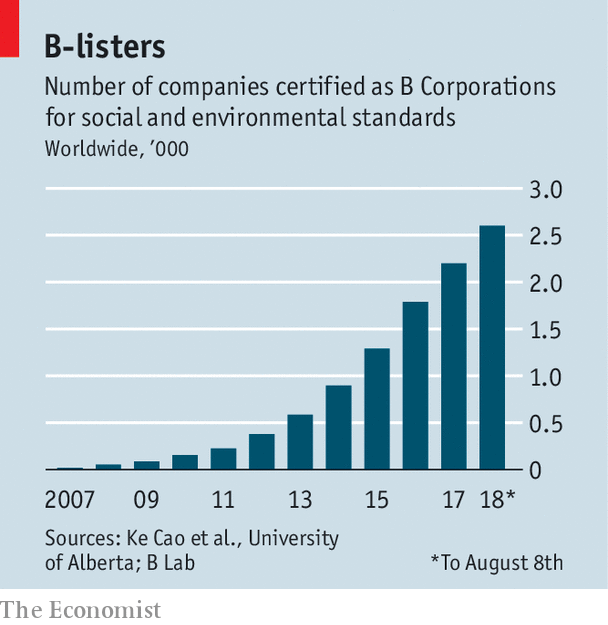
The B Corp movement has been building slowly since its inception in 2007. As of this writing, there are 2,788 certified businesses across 150 industries and 64 countries. This number is rising quickly, and in 2018, Danone North America became the largest Certified B Corporation
in the world, with annual revenues over $6 billion. Danone North America proved that becoming certified is not a privilege exclusive to small- and medium-sized businesses - it is accessible to anyone.
Becoming a Certified B Corporation is often done for internal reasons, such as it aligning with an organization’s core values and company culture. It is the ultimate demonstration of becoming a “business with a purpose,”
and using business to serve the greater good.
In addition to the internal benefits, becoming a Certified B Corporation also has many external benefits. These include: improving stakeholder relations, strengthening employee loyalty, increasing customer loyalty, attracting impact investors, and joining a growing community of purpose-driven business leaders. Becoming a Certified B Corp also provides businesses with a very objective and quantifiable method for tracking improvements over time. Tracking improvements over time aligns very closely with our personal philosophy at VTS: “Sustainability is a journey, not a destination.”
Call to Action
If you're curious about becoming a Certified B Corporation and would like to get a baseline understanding of how your organization's sustainability program stacks up against the best in the world, consider taking the B Impact Assessment. It will give you a solid idea of what your strengths and weaknesses are, along with how much work it will take to reach the minimum score of 80 points. Although the full B Impact Assessment may take several hours to complete, a condensed version called the Quick Impact Assessment will require less time. They can both be accessed here: B Impact Assessment.
Conclusion
While becoming a Certified B Corporation is certainly not mandatory to become a “Sustainable Business,”
it presents a lofty yet attainable target for businesses looking to take their sustainability program to the next level.
We hope you enjoyed learning about the Certified B Corporation. To learn more, we recommend reading the B Corp Handbook, which was a main source for some facts presented in this article. We also suggest larger companies interested in certifying read Danone North America’s Story.
If you liked what you read and want to learn more, please sign up
for our monthly newsletter and follow us on instagram. By doing so, you’ll receive our newest articles and insights straight to your inbox once each month.